Safety-first, Indonesia-native clinical AI for frontline healthcare. Meet NadiDesa →
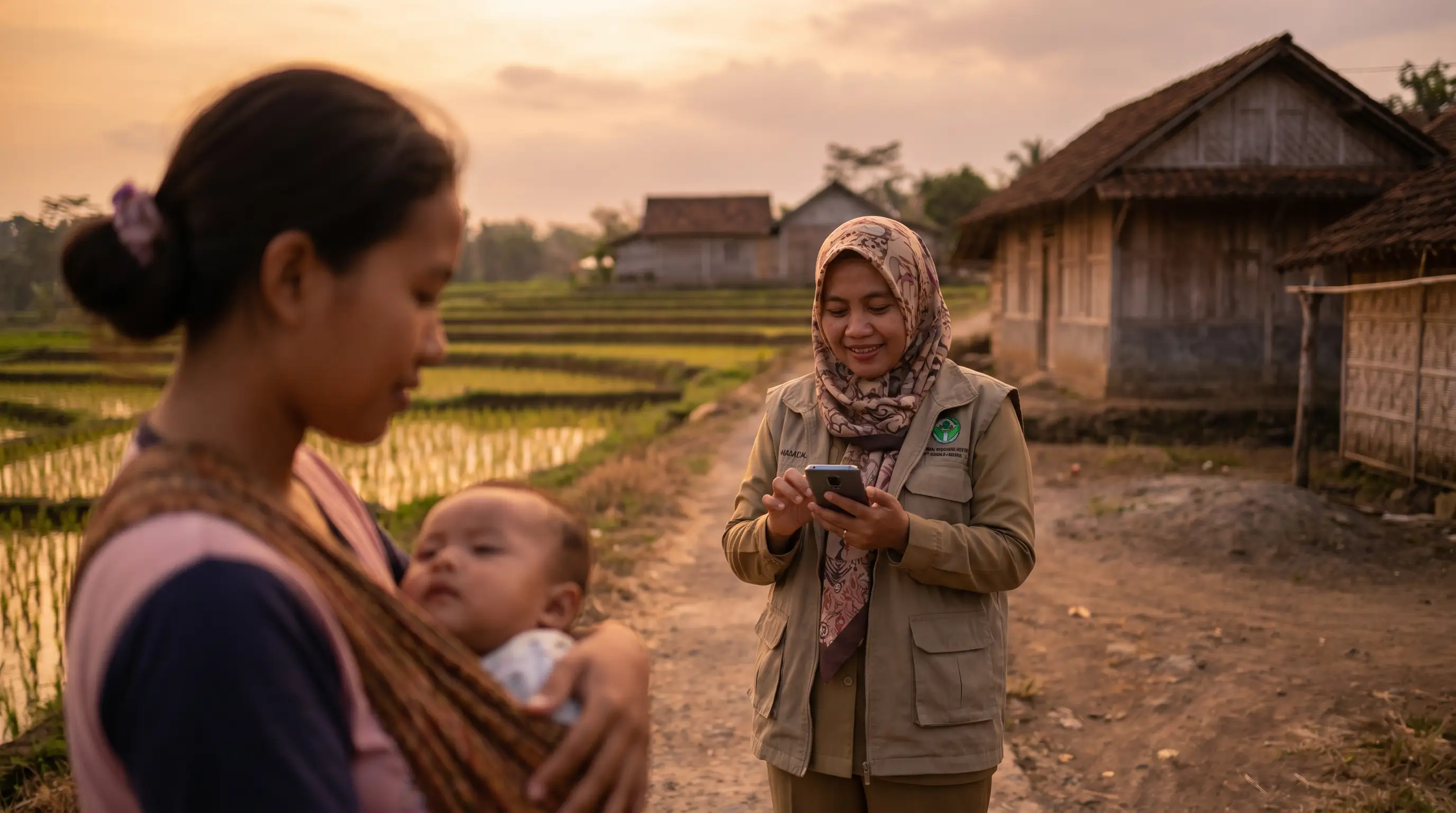
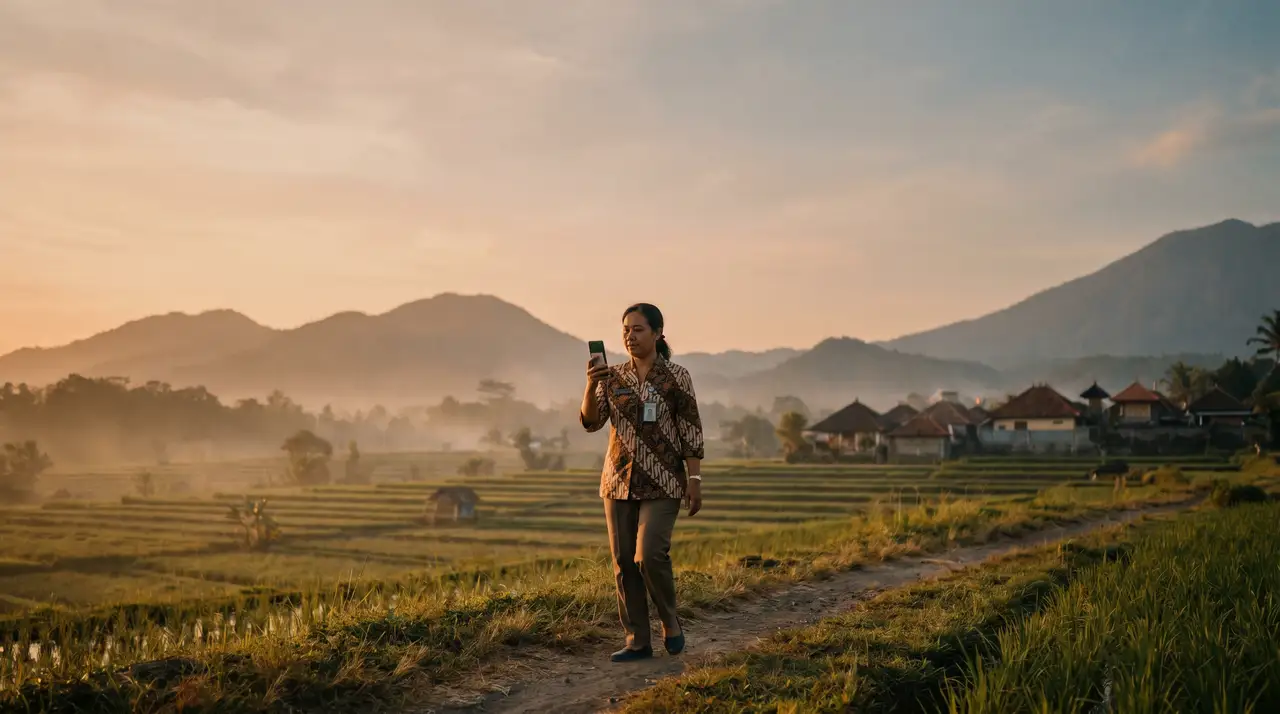
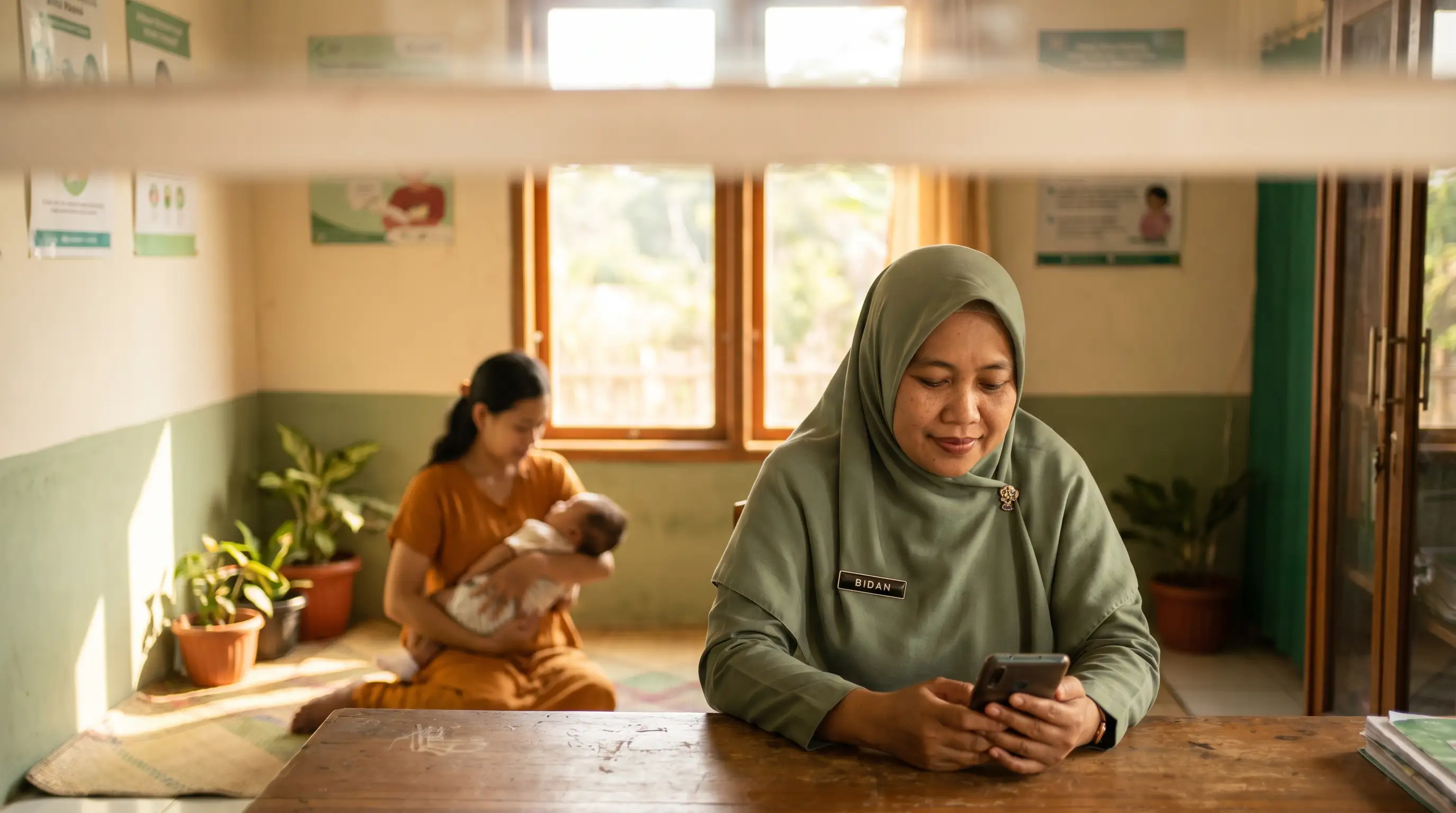
An Indonesian village health worker walking through terraced rice fields at golden hour, holding a phone An Indonesian midwife reviewing a phone in a village health post while a mother and baby sit nearby Close view of a health worker's hands holding a phone beside a notebook, rice fields behind
One phone · One village server · One safer next step

Safety-first AI for Indonesia's frontline healthcare.

TheNalara is an Indonesia-native clinical AI lab building safe, local-first intelligence for the health workers closest to communities, starting with NadiDesa.

Offline-first
Works with no signal, no cloud dependency.
3-layer safety
Model · Safety Core · Bidan approval.
Human-in-the-loop
A clinical support system, not an AI doctor.
Where healthcare begins

Healthcare doesn't always begin in a hospital.

In many parts of Indonesia, healthcare does not begin inside a large hospital. It begins in a village, at a family doorstep, in a small clinic, or in a moment when a Kader or Bidan must decide what to do next with limited information and limited time.

The internet may be unavailable. The nearest doctor may be far away. A clinic may have limited equipment. A mother, a child, or a family may still need a safe next step before the formal health system can fully respond.

TheNalara exists for that moment.

NadiDesa by TheNalara

Offline clinical AI support for Kader, Bidan, and village care teams.

NadiDesa is designed for villages and low-connectivity environments where the first point of care is often not a doctor, but a frontline health worker who must collect information, recognize risk, prepare a handoff, and escalate at the right time.

Most medical AI assumes the internet exists. NadiDesa assumes it may not.

Offline-first triage

Local triage and screening that works with no signal and no cloud dependency.

Structured case collection

Guided intake that captures the right information, consistently, every time.

Danger sign detection

Early recognition of warning signs that warrant faster escalation.

Bidan-reviewed guidance

Sensitive guidance is reviewed and approved by a Bidan before it reaches the Kader.

Local village server support

Deeper reasoning runs on a nearby server over local WiFi, not a distant cloud.

Audit trail for reviewability

Every case produces a reviewable record for accountability and learning.

A safer support layer

Not an AI doctor. A safer support layer.

NadiDesa does not replace doctors, Bidan, nurses, or licensed clinicians. It is a human-in-the-loop clinical support system built to help health workers collect better information, recognize risk earlier, prepare clearer case summaries, escalate appropriately, and coordinate with a Bidan before sensitive guidance is shown.

The most important feature of a healthcare AI system is not only intelligence. It is restraint.

By design
NadiDesa is designed to know what it must not do.
If a request involves medication guidance, dosage logic, contraindication reasoning, diagnosis, or a decision that should not be made locally, the system blocks the local answer and routes the case for higher review.
The safety principle

The model proposes. The Safety Core validates. The Bidan approves.

1

The model proposes

The Nalara model layer may summarize the case, identify missing information, suggest a triage category, or recommend escalation.

Nalara model layer
2

The Safety Core validates

TheNalara Safety Core checks required fields, danger signs, escalation rules, safety boundaries, and clinical constraints.

Deterministic validation
3

The Bidan approves

For sensitive guidance, the Bidan reviews and approves the next step before the Kader sees the final instruction.

Human-in-the-loop
How NadiDesa works

From a doorstep at night to a safe, reviewed next step.

Scenario

A Kader visits a family at night. A child has fever, cough, and fast breathing. The phone has no signal. The Kader opens NadiDesa and enters the child's age, symptoms, and key vital signs.

1

Kader enters structured case data.

2

Phone performs local triage and danger sign screening. Fully offline.

3

If deeper reasoning is needed, the phone connects to the local village server over WiFi.

4

The Nalara model layer creates a structured proposal.

5

TheNalara Safety Core validates the proposal.

6

The Bidan reviews and approves sensitive guidance.

7

The Kader receives a safe next step: referral instruction, danger signs, follow-up timing, and a patient-friendly explanation.

8

An audit trail is created for review.

Built for Indonesia's real conditions

Indonesia-native, from the ground up.

TheNalara is not simply translating a Western medical AI product into Bahasa Indonesia. It is building Indonesia-native clinical AI from the ground up: local language, local workflows, local infrastructure limits, local escalation pathways, and local clinical supervision.

NadiDesa begins with maternal-child and primary care workflows because these are frequent, high-consequence, and deeply connected to Indonesian village healthcare.

Initial focus areas
Child fever and cough Fast breathing & pneumonia risk Maternal danger signs Pregnancy follow-up Postpartum follow-up Newborn warning signs Referral preparation Kader → Bidan handoff
An Indonesian community health worker using a phone beside a mother holding her baby in a village at golden hour
TheNalara system

One brand. One product. One safety architecture.

Company · AI Lab

TheNalara

The institutional brand for research, partnerships, publishing, healthcare stakeholders, and public trust.

First product

NadiDesa by TheNalara

Offline clinical AI support for Kader, Bidan, and village care teams.

Model family

Nalara

The public-facing intelligence layer powering local clinical workflows.

Safety layer

TheNalara Safety Core

Deterministic validation, escalation rules, boundary checks, and human-in-the-loop governance.

Technical namespace

thenalara

Domains, APIs, model IDs, repositories, and infrastructure labels.

The road ahead

Toward Indonesia-native clinical AI infrastructure.

NadiDesa is the first product because it captures the soul of TheNalara. It begins with the people who are usually last to receive advanced technology. It is built for the realities of Indonesia: limited connectivity, fragmented care pathways, local language needs, and the central role of Kader and Bidan in community health.

Over time, NadiDesa can evolve from offline triage and referral support into structured case records, Bidan dashboards, clinic handoffs, maternal-child follow-up, documentation support, interoperability with health record systems, and safer workflows from village to clinic to health system.

The broader vision is not simply to build an AI application. It is to build clinical AI infrastructure: safe enough for healthcare, local enough for real deployment, practical enough to serve the first mile of care.
The roadmap · Now · Next · Later
Now2026

Prove safety at the first mile

Offline clinical support for maternal-child care, with Kader and Bidan in the loop, and the Safety Core proven in the field.

  • Offline triage & danger-sign detection
  • Bidan-reviewed referral preparation
  • Safety Core validation & audit trail
  • First field pilots with community-health partners
Next2026–27

From triage to continuity

Turn safe single moments into a connected record that follows the patient from village to clinic.

  • Structured case records
  • Bidan review dashboards
  • Kader → Bidan → clinic handoff
  • SATUSEHAT-aligned interoperability
  • Primary care, pharmacy & lab-result safety
Later2027 +

Indonesia-native clinical AI infrastructure

A safety-validated clinical AI layer the wider health system can build on.

  • Village → clinic → hospital → system continuity
  • Multi-region deployment
  • Public-health & multilateral partnerships
  • A safety layer others can build on
Founders

Built in Indonesia, by the people closest to the problem.

TheNalara pairs deep technical building with decades of access-first strategy, so safe clinical AI actually reaches the frontline.

Fahmi Hidayat

Fahmi Hidayat

Co-Founder

Self-taught engineer and four-time international AI hackathon winner. Fahmi leads all technology and product at TheNalara. He built NadiDesa's offline Safety Core, the on-device clinical models, and the village-server architecture that runs without the cloud.

Nelly Sutjiadi

Nelly Sutjiadi

Co-Founder

AI strategist and impact investor with three decades building inclusive technology. Nelly leads strategy, partnerships, and access, connecting TheNalara to the health systems, funders, and communities it serves.

Get in touch

Building safer clinical AI for the first mile of care.

TheNalara is building safety-first, Indonesia-native clinical AI for frontline care, starting with NadiDesa.